
Computer Straight Forecast: History and Evolution Since 1977
 Available in US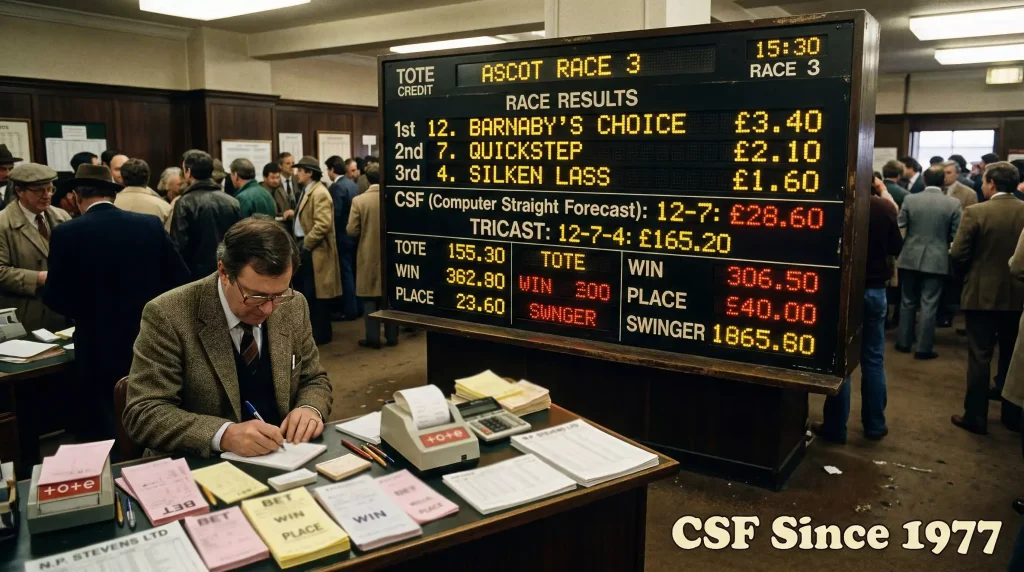
The Computer Straight Forecast—CSF—is the formula that determines your tricast dividend. Introduced in 1977, it replaced inconsistent bookmaker-set dividends with a standardised calculation based on Starting Prices. Nearly fifty years later, it remains the foundation of exotic bet settlement across British racing.
Understanding the CSF’s history explains why tricast dividends work as they do. Before 1977, punters faced arbitrary payouts that varied between bookmakers. The CSF brought fairness, consistency, and transparency—or at least as much transparency as a proprietary algorithm permits.
The extension of CSF principles to tricast betting followed naturally. If forecasts could be calculated uniformly, so could tricasts. The same logic applied: use Starting Prices to generate dividends that reflect the difficulty of correct prediction.
This evolution from chaos to standardisation transformed exotic betting into a credible market segment rather than a bookmaker speculation opportunity. The reform benefited punters and operators alike by establishing trust in dividend calculations.
Computer Straight Forecast — More on this topic at tricast horse racing.
Pre-CSF Era
Before 1977, forecast betting existed but lacked standardisation. Each bookmaker set their own dividend for winning forecasts, with no obligation to match competitors or follow any consistent formula. A winning forecast might pay £50 at one shop and £80 at another—or vice versa.
This inconsistency created problems for punters and the industry. Bettors could not compare value between operators without waiting for results and hoping their chosen bookmaker offered fair terms. Some bookmakers used forecast dividends as competitive differentiators; others viewed them as profit centres to be minimised.
The potential for manipulation existed. A bookmaker knowing the result before publishing their dividend could set payouts advantageously. While most operators acted honestly, the lack of external verification created suspicion and undermined confidence in forecast betting as a fair product.
Tote pool betting offered an alternative—the exacta used parimutuel principles with dividends determined by actual betting patterns. But the Tote was not universally accessible, and many punters preferred betting with their regular bookmaker despite the dividend uncertainty.
Industry voices called for reform. A standardised calculation, applied uniformly across all bookmakers, would eliminate manipulation concerns, enable value comparison, and establish forecast betting as a credible product category.
The question was how to implement such a system. Any formula needed to be fair, defensible, and practical to calculate quickly after each race—before the era of instant computing, this presented genuine logistical challenges.
The betting industry collaborated on a solution. Bookmaker associations, racing authorities, and technical experts worked together to design a formula that could achieve industry-wide acceptance while remaining computationally feasible.
The 1977 Introduction
The Computer Straight Forecast launched in 1977 through industry agreement. Bookmakers committed to using a standardised formula for forecast dividend calculation, with all operators paying the same CSF dividend for any given result.
The formula uses Starting Prices as its primary input. The SPs of the first and second finishers, combined with the SP of the favourite and their finishing position, feed into calculations that produce the dividend. Additional factors account for field size and other race characteristics.
The exact algorithm is proprietary. Published explanations describe inputs and general principles, but the precise mathematical formula remains confidential. This opacity frustrates some punters who want to verify calculations, but the consistency of application across operators provides practical assurance of fairness.
Computer calculation was essential—hence the name. Manual dividend computation for every forecast combination in every race would be impossibly slow. Electronic processing enabled instant results, with dividends available shortly after Starting Prices were confirmed.
The reform succeeded in its goals. Forecast betting gained credibility as a fair product. Punters could bet with any bookmaker knowing the dividend would be identical. Value comparison shifted to factors like stake limits and service quality rather than payout variations.
The CSF became so embedded in British racing that many punters assume it has always existed. Its 1977 introduction feels like ancient history, but it represents relatively recent modernisation in betting industry terms.
The success of the CSF demonstrated that industry-wide standardisation could work. Competing bookmakers agreed to use identical calculations, prioritising market integrity over individual competitive advantage. This cooperation set precedents for future regulatory developments.
See also Pool Betting vs Fixed Odds.
Extension to Tricast
The same principles that standardised forecasts naturally extended to tricasts. Predicting the first three requires the same fundamental approach—use Starting Prices to generate a dividend reflecting the prediction’s difficulty.
Tricast calculation is more complex than forecast calculation. More variables enter the formula: the SPs of three finishers rather than two, their relative positions, and the expanded field of possibilities that three-horse predictions create.
The factors influencing tricast CSF include: the Starting Prices of all runners in the race, the SPs of the first, second, and third finishers specifically, the favourite’s SP and finishing position, field size, race type, and known draw biases at certain courses. Each element contributes to the final dividend.
Draw bias adjustment proved particularly important for tricasts. At courses with pronounced advantages for certain stall positions, results that align with those advantages are less surprising than raw odds suggest. The CSF accounts for this, compressing dividends when predictable patterns emerge.
The Victoria Cup 2022 illustrated this effect dramatically. Three horses from high draws—favoured at Ascot—finished 1-2-3 at odds of 16/1, 22/1, and 25/1. The expected tricast based on those odds alone was £8,700 to £9,300. The actual CSF dividend: £4,377. The formula recognised the result was more predictable than the prices suggested.
Tricast CSF calculation happens centrally and applies uniformly across all participating bookmakers. The same dividend is paid whether you bet online, in-shop, or through any licensed operator. This consistency—extending the 1977 forecast reform to three-horse predictions—ensures tricast betting operates fairly across the industry.
Minor variations exist in presentation. Some bookmakers show projected dividends before races; others display only final results. The underlying calculation is identical—only the timing and format of information differs.
The CSF continues evolving. Refinements to the algorithm address changing market conditions and incorporate improved statistical understanding. The core principles remain stable, but implementation details may adjust over time to maintain accuracy and fairness.
For tricast bettors, the practical implication is clear: dividends are determined fairly and consistently. Focus your energy on selecting the right horses rather than worrying about whether you will receive fair treatment from your chosen bookmaker.
Standardising the Dividend
The CSF transformed exotic betting from a fragmented, potentially manipulable product category into a standardised market operating fairly across the industry. The 1977 reform and its extension to tricasts established principles that endure nearly fifty years later.
For punters, the CSF provides assurance. Your tricast dividend reflects a consistent calculation applied uniformly, not arbitrary bookmaker decisions. You can bet with confidence that fair treatment applies regardless of operator.
The formula’s opacity remains a valid criticism—punters cannot independently verify specific calculations. But the consistency of application across operators, combined with regulatory oversight, provides practical confidence that the system operates as intended.
Understanding CSF history helps appreciate why tricast dividends sometimes surprise. The formula incorporates factors beyond simple odds multiplication. When dividends seem lower than expected, factors like draw bias or favourite positioning may explain the compression. The CSF sees patterns that casual observation might miss.
The standardisation achieved in 1977 remains one of the betting industry’s quiet successes—so successful that most punters never consider alternatives or appreciate the chaos that preceded it.
