
UK Tricast Betting: The Complete Guide to Predicting the Podium
 Available in US
Predict the podium. Understand the payout.
A tricast bet asks you to predict the exact 1-2-3 finish order. It is one of the most challenging single-race wagers available, with returns that can transform modest stakes into five-figure payouts.
Start Reading
Aintree, April 2025. Nick Rockett crosses the line at 33/1, followed by I Am Maximus and Grangeclare West. All three trained by Willie Mullins—a historic clean sweep that nobody saw coming. Somewhere in Britain, a punter stares at their betting slip: an £8 each-way tricast that has just become worth over £61,000.
That story captures everything compelling about tricast betting. It demands precision—predicting not just a winner, but the exact order of the first three finishers. It punishes overconfidence and rewards those who spot value where others see chaos. And when it lands, the returns can be extraordinary.
A tricast bet asks you to predict the podium: first, second, and third, in that specific sequence. It sits at the more challenging end of horse racing wagers, above the win bet (single position) and the forecast (two positions). The complexity is the point. Bookmakers offer substantial dividends precisely because picking three horses in order is genuinely difficult.
This guide covers everything a British punter needs to understand tricast betting properly. You will learn the mechanics—straight versus combination tricasts, how the Computer Straight Forecast formula generates your dividend, and what happens when horses scratch or dead-heat. You will see data from over a thousand races comparing tricasts to their Tote equivalent, the trifecta. You will study the record-breaking payouts that demonstrate what is possible, and you will pick up practical strategies for selecting your three horses and managing your bankroll sensibly.
Whether you are placing your first tricast or refining an existing approach, the aim is to move beyond guesswork toward informed decision-making. Predicting the podium is never easy—but understanding the bet makes it considerably less mystifying.
Tricast Ledger
The Tricast Fundamentals at a Glance
- A tricast requires predicting horses to finish first, second, and third in exact order—available only on UK handicap races with eight or more declared runners.
- Straight tricasts cost one unit and demand precise order; combination tricasts cover all six permutations for six times the stake.
- Research across 1,011 UK and Irish races shows trifecta (Tote pool) pays 26% more than tricast (bookmaker CSF) on average, winning the comparison in four out of five races.
- Non-runner rules convert your tricast to a forecast if one horse scratches, to a win single if two scratch, or void the bet entirely if all three withdraw.
- Record UK tricast payouts exceed £95,000, with the 2025 Grand National delivering £61,000 from an £8 each-way stake.
What Is a Tricast Bet?
Tricast — A bet requiring the selection of horses to finish first, second, and third in a single race, in the exact order specified. Available exclusively on UK and Irish handicap races with a minimum of eight declared runners.
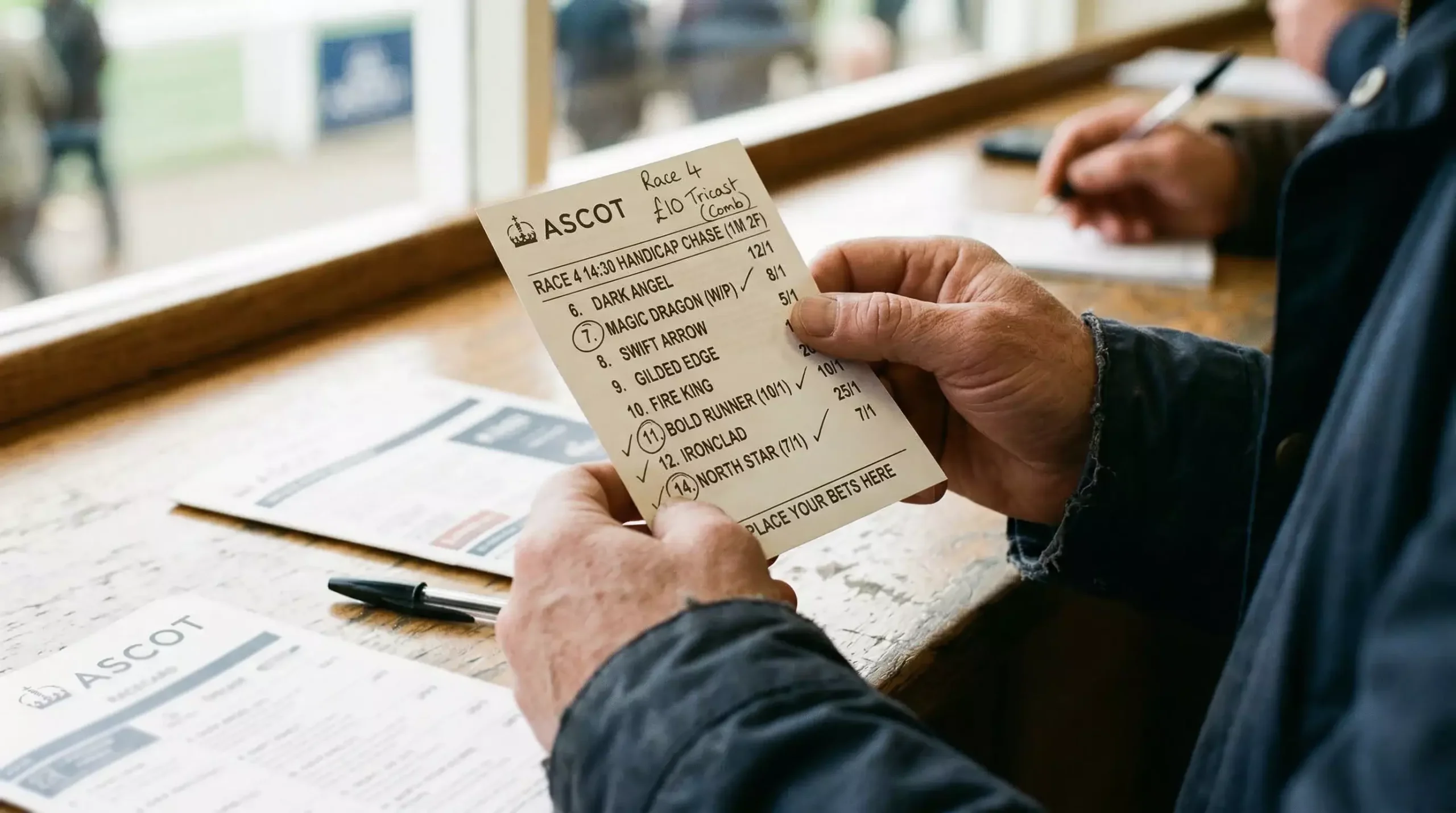
The name combines "tri" (three) with "forecast," reflecting its structure as an extended version of the forecast bet. Where a forecast asks you to predict the first two finishers in order, a tricast adds a third selection—and with that additional layer comes substantially increased difficulty and correspondingly higher potential returns.
Consider a practical example. You are studying the 3:45 at Newmarket, a competitive handicap with fourteen runners. After analysing form, you believe Silver Strike will win, Moonlight Bay will finish second, and Lucky Charm will claim third. A tricast bet locks in that exact sequence. If Silver Strike wins but Moonlight Bay and Lucky Charm swap positions—finishing third and second respectively—your tricast loses. The order matters absolutely.
This precision distinguishes tricasts from other exotic wagers. An accumulator links multiple events but does not demand positional accuracy. A win bet requires only that your horse finishes first. Even a forecast, while requiring order, involves just two horses. The tricast's requirement of three-in-sequence makes it one of the most challenging single-race bets available.
Availability restrictions exist for sensible reasons. According to official bookmaker rules, tricasts are accepted only on handicap races with at least eight declared runners, of which a minimum of six must actually start. These thresholds ensure sufficient field competitiveness—without them, results would be too predictable to justify the large dividends that make tricasts attractive.
Handicap races level the playing field by assigning different weights to horses based on their assessed ability. The official handicapper's job is to give every horse a theoretical equal chance, which produces genuinely open races with multiple plausible outcomes for each placing. This competitive uncertainty creates the conditions under which tricast betting becomes viable.
Non-handicap races—conditions races, listed events, and Group contests—do not offer tricast markets. These races often feature smaller fields and clearer form differentials, making the first three places more predictable. When Racing Post lists tricast dividends after a race, it is always following a handicap.
The practical consequence is that tricast opportunities cluster around the middle-distance handicaps that form the backbone of British racing. Big Saturday handicaps at the major meetings, midweek cards at tracks like Lingfield and Wolverhampton, and the competitive mile-and-a-half events that attract large fields all regularly support tricast markets.
Straight Tricast vs Combination Tricast
Once you have identified three horses capable of filling the podium places, you face a fundamental decision: are you confident enough to specify the exact order, or would you prefer to cover all possible arrangements? This choice determines whether you place a straight tricast or a combination tricast.

The Straight Tricast
A straight tricast locks in a single sequence. You select Horse A to finish first, Horse B second, and Horse C third. If the race unfolds exactly as predicted, you win. Any other finishing order among your three selections results in a losing bet.
The appeal is cost efficiency. A £1 straight tricast costs precisely £1. Your stake exposure is minimal, and if your analysis proves accurate, you collect the full Computer Straight Forecast dividend without having diluted your position across multiple permutations.
Straight tricasts suit situations where you have genuine conviction about order. Perhaps one horse has clear class superiority but tends to idle in front—making it a probable winner but unlikely to pull far ahead. Perhaps another is a noted strong finisher but rarely quite gets up in time. When your assessment of running styles and likely race dynamics points toward a specific sequence, backing that sequence exclusively maximises your return-per-pound-staked.
The Combination Tricast
A combination tricast covers every possible ordering of your three selected horses. Mathematically, three horses can finish in six different sequences: ABC, ACB, BAC, BCA, CAB, and CBA. A combination tricast backs all six permutations as separate straight tricasts, meaning a £1 combination actually costs £6.
The trade-off is straightforward. You accept a sixfold increase in stake cost in exchange for winning as long as your three horses finish first, second, and third in any order. If they fill those positions but in an arrangement you would not have predicted, you still collect—though your effective return is reduced by the higher total stake.
| Characteristic | Straight Tricast | Combination Tricast |
|---|---|---|
| Cost per £1 unit stake | £1 | £6 |
| Permutations covered | 1 | 6 |
| Order required | Exact sequence only | Any order of selected horses |
| Risk profile | Higher risk, higher potential ROI | Lower risk, lower return per unit staked |
| Best suited for | Strong conviction on finishing positions | Confidence in horses, less certainty on order |
Calculating Effective Returns
Suppose a race finishes with your three selections filling the frame, and the declared tricast dividend is £1,200 to a £1 stake. With a straight tricast, you collect £1,200. With a combination tricast at £1 per line, you collect £1,200 but have invested £6, making your net profit £1,194—a return of 199 times your total outlay rather than 1,200 times.
In percentage terms, the combination tricast produces an 83% lower return on investment compared to hitting the same result with a straight tricast. That gap widens the larger the dividend: on a £10,000 tricast, the difference between netting £9,994 (combination) and £9,999 (straight) matters less than on a £500 return where the differential is £494 versus £499.
Which Should You Choose?
The decision ultimately rests on your assessment of order predictability. If the three horses you fancy are closely matched and the race dynamics could plausibly produce several different sequences, a combination covers your uncertainty at a manageable cost. Six pounds is not an unreasonable price to ensure you benefit from any ordering of horses you believe will dominate.
If, however, you have studied the likely race pattern and concluded that one horse will make all, another will finish strongly for second, and a third will plug away for third without threatening higher, a straight tricast puts your conviction to the test with maximum reward if proven correct.
Many experienced tricast bettors use both approaches depending on circumstances. Big-field handicaps where pace tends to be even might favour combinations; smaller fields with a clear pace angle might justify straights. There is no universally superior option—only the one better suited to each specific race you analyse.
Tricast vs Trifecta: The Data-Driven Truth
British punters predicting the first three home have two options: a tricast with a bookmaker or a trifecta through the Tote. Both require the same selection skill, but payout mechanisms differ fundamentally.

How They Differ
A tricast is a bookmaker bet with returns calculated post-race using the CSF formula. A trifecta is a pool bet—stakes go into a shared pool, the Tote takes a deduction, and winnings are divided among ticket holders.
"As far as punters are concerned, the key difference between the two bets is how winnings are calculated," explains David Renham, racing analyst at geegeez.co.uk. "The tricast is a bookmaker bet, where the returns are computed and generated, giving the bookmaker a healthy margin, whereas the trifecta is a Tote pool bet."
What the Data Shows
Analysis of 1,011 UK and Irish handicap races from 2023 found the average trifecta payout was 26% higher than tricast. In 80% of races, trifecta produced the higher payout, winning by an average margin of 59% when it did.
In 80% of races, trifecta pays more than tricast. When it wins, it wins by a larger margin than tricast does in the minority where tricast pays better.
A follow-up analysis found 14.3% of races saw trifecta pay at least double the tricast; the reverse occurred in just 2% of races.
The Deduction Factor
According to Tote betting rules, the Totetrifecta deduction is 25% in the UK, rising to 30% in Ireland. Despite this, trifectas still tend to pay better—suggesting the CSF formula builds in a margin exceeding the Tote's stated deduction.
Field Size Influence
In races with 12 to 14 runners, the trifecta advantage exceeded 25%. In smaller fields of 10 to 11 runners, the gap narrowed to approximately 14%. Larger fields create more combinations, making specific outcomes less likely to attract heavy pool backing.
Practical Implications
The data tells a clear story: trifecta offers better expected returns in most scenarios, particularly in larger fields. Tricast remains convenient and available with any operator, but on big handicaps the statistical evidence favours trifecta as a default.
How Tricast Dividends Are Calculated
When your tricast lands, the payout is not determined by simple multiplication of starting prices. Instead, bookmakers use the Computer Straight Forecast formula—a mathematical model designed to generate consistent, defensible dividends that account for the competitive dynamics of each individual race.
The CSF Formula: History and Purpose
The Computer Straight Forecast system was introduced in 1977 to standardise forecast and tricast returns across the British betting industry. Before its implementation, dividends were calculated through manual processes that produced inconsistent results between bookmakers. The CSF brought algorithmic consistency: the same race produces the same declared dividend whether you bet with William Hill, Ladbrokes, or an independent.
The exact formula is proprietary and unpublished, but the factors that influence it are understood. The calculation incorporates the starting prices of all horses in the race, not just the first three. It considers the starting prices of the actual first, second, and third finishers specifically. The position of the favourite matters—whether the favourite won, placed, or finished outside the places affects the dividend. The type of race and, crucially, the draw bias characteristics of the course all feed into the calculation.
CSF Factors: Starting prices of all runners • SP of first three finishers • Favourite position • Race type • Course draw bias characteristics
Why Results Can Surprise
Because the formula accounts for draw bias, identical starting price combinations can produce significantly different dividends at different courses. A vivid example occurred at the Victoria Cup in 2022. The first three home had starting prices of 16/1, 22/1, and 25/1—all from high-numbered stalls on a day when the draw strongly favoured high numbers.
A naive calculation based purely on those prices would suggest a tricast dividend in the range of £8,700 to £9,300. The actual dividend: £4,377. The CSF formula had factored in the draw bias, recognising that while the raw prices looked surprising, the track conditions made high-draw horses predictably advantaged that day. The result was less unlikely than prices alone suggested, so the dividend reflected that reduced element of surprise.
Draw Bias Warning: When a track rides strongly to high or low numbers, the CSF formula adjusts dividends downward. A result that looks like a 100/1 tricast combination might pay at 50/1 effective odds if the draw made it statistically more probable.
Favourite Position and Dividend Suppression
The favourite's finishing position also significantly influences payouts. If the favourite wins, the tricast dividend tends to compress, even if the second and third are longshots. The formula's weighting assumes that a favourite winning is inherently less surprising than a favourite finishing out of the places, regardless of what follows.
Conversely, when a favourite finishes completely unplaced—outside the first three—tricast dividends tend to inflate. The formula treats this as evidence that the race produced a genuinely unexpected result, justifying higher returns to those who correctly predicted the actual placed horses.
Calculating Expectations
Given the formula's complexity and unpublished nature, no punter can calculate exact tricast dividends before a race. However, rough estimates are possible.
A basic approximation multiplies the win prices of the first three together, then applies a reduction factor. If Horse A wins at 10/1, Horse B finishes second at 8/1, and Horse C third at 15/1, the product is 10 × 8 × 15 = 1,200. Applying a typical reduction factor of around 0.4 to 0.6 (depending on field size and other variables) gives an estimated dividend between £480 and £720 to a £1 stake.
This remains an estimate only. The actual CSF dividend might be higher if the result was genuinely surprising relative to market dynamics, or lower if factors like draw bias or favourite position reduced the implied improbability.
Why Transparency Matters Less Than You Think
The formula's opacity occasionally frustrates punters, but its practical impact on betting strategy is limited. You cannot game the CSF—it applies post-race to whatever result occurs. What you can do is select races where competitive dynamics favour unpredictable results: large fields, even pace expectations, no obvious draw advantage. These conditions tend to produce races where genuine surprises occur and dividends reflect that genuine surprise, rather than being suppressed by track or market factors.
Tricast Calculator: Estimate Your Potential Returns
Before placing a tricast, knowing the approximate range of potential returns helps with stake sizing and expectation management. While exact dividends depend on post-race CSF calculation, calculators provide useful estimates.
How Tricast Calculators Work
A tricast calculator takes the starting prices of three selected horses and estimates the dividend using a simplified CSF model. Input odds for your first, second, and third selections, choose straight or combination, enter your stake, and receive an estimated payout range.
The calculation typically multiplies prices together and applies a reduction factor approximating CSF adjustments. Better calculators account for field size and offer ranges rather than single figures.
Using Calculator Results
Estimates serve three purposes. First, they gauge whether a tricast offers value worth pursuing—compare estimated returns against your probability assessment. Second, they inform stake sizing: larger potential returns can justify smaller stakes. Third, they highlight price sensitivity—shifting one selection from 10/1 to 14/1 might increase estimates by 40%.
Limitations
No calculator predicts exact dividends. The CSF incorporates variables calculators cannot model pre-race: starting prices of non-selected horses, favourite position, and course-specific draw adjustments.
Estimation Only: Actual dividends are declared post-race. Pre-race estimates may vary significantly, particularly in races affected by draw bias.
Calculators assume your horses finish exactly as selected—they do not factor probability. An £8,000 estimated return is meaningless if the combination has a one-in-fifty-thousand chance. Pair dividend estimates with honest probability assessments.
Tricast Rules: Non-Runners and Dead Heats
Horses withdraw from races; others finish inseparably close. Understanding how these scenarios affect your tricast prevents unpleasant surprises.
Non-Runner Rules
According to standard bookmaker rules, settlement follows a clear hierarchy:
One non-runner: Your tricast converts to a straight forecast on the remaining two horses. Returns are lower but your bet remains live.
Two non-runners: The tricast becomes a win single on the remaining horse at starting price.
All three non-runners: The bet is void and your stake is returned.
Settlement Summary: 1 non-runner → Forecast. 2 non-runners → Win single. 3 non-runners → Void.
Consider horse reliability when selecting. Horses with injury concerns, marginal ground preferences, or trainers known for late withdrawals carry additional conversion risk.
Dead Heat Rules
When horses finish inseparably close, dead heats trigger proportional settlement. If your winner dead-heats for first, you receive half the dividend. Dead heats for second or third work similarly.
These rules can combine. A dead-heat for second involving your selections might result in quarter-dividend settlement. Combination tricasts face additional complexity—multiple permutations might technically win, each at reduced dividends.
After races involving non-runners or dead heats, verify your settlement. Your bet history should show the settlement basis alongside your return.
Minimum Runners for Tricast Bets
Tricast availability depends on field size and race type. Understanding these requirements identifies which races offer tricast markets.
The Eight-Runner Threshold
For tricast betting, a minimum of eight horses must be declared, with at least six actually starting. If late withdrawals reduce the field below six starters, tricasts are void and stakes returned.
The rationale is competitive legitimacy. Eight declared runners ensures at least 336 possible exact-order permutations for the first three places, creating sufficient complexity for genuine prediction challenge.
Handicap Races Only
Tricasts are restricted to handicap races. Conditions races, listed events, and Group races do not offer tricast markets regardless of field size.
Handicaps are designed to equalise chances through weight allocation, creating genuinely open races. Non-handicap races often feature clear class differentials where predicting the first three becomes recognition of quality gaps rather than form analysis.
Identifying Tricast Races
Check race conditions in the Racing Post or on bookmaker websites. Handicap races are clearly marked with field sizes shown at declaration stage. Saturday features and big betting races reliably offer tricast markets.
Late withdrawals can remove availability. A race with nine declared might drop to seven actual runners, voiding your tricast. Monitor final declarations where possible.
Field Size Strategy
Research suggests larger fields produce greater trifecta advantage over tricast—exceeding 25% in 12 to 14 runner races. Smaller fields narrow that differential. Bigger fields create more uncertainty and potentially more rewarding outcomes.
How to Place a Tricast Bet: Step by Step
Whether betting online or in a shop, the process follows consistent principles across UK bookmakers.
Step 1: Select an Eligible Race
Navigate to horse racing markets and identify a handicap race with eight or more declared runners. Tricast markets appear alongside win and forecast options—if tricast is absent, the race does not meet minimum requirements.
Step 2: Open the Tricast Market
Click on the tricast section for your chosen race. Some platforms combine forecast and tricast markets; others separate them.
Step 3: Select Three Horses
For a straight tricast, specify which horse finishes first, second, and third. Interface designs vary—dropdown menus, sequential clicks, or position grids. For a combination tricast, select three horses without position assignments. Confirm the bet type displays correctly before proceeding.
Step 4: Enter Your Stake
Input your stake. For straight tricasts, this is your total outlay. For combinations, the displayed amount is per permutation—£1 means £6 total across six combinations. Verify the total before confirming.
Step 5: Review and Confirm
Check selections, positions, and stake. Verify the race, meeting, and time match your intent. Click "Place Bet" and save the confirmation reference.
Step 6: Post-Race Settlement
Bets settle automatically based on the declared CSF dividend. Non-runners or dead heats trigger adjusted settlement rules—forecast conversion, proportional deduction, or void status as applicable.
Common Mistakes
Confusing straight and combination tricasts causes problems. Confirm bet type explicitly. Misjudging combination stakes remains the most common financial error—always multiply unit stake by six for total cost.
Tricast Strategy Tips from the Paddock
"These bets are incredibly difficult to win because you must correctly predict the first, second, and third horses home in a specific race," notes David Renham, racing analyst at geegeez.co.uk. "We all know that finding the winner can sometimes be a challenge, let alone the first three!"

That difficulty is precisely why strategy matters. Random tricast selection offers negligible expected returns over time. Informed selection, while still challenging, at least puts you in positions where value might exist.
Target the Right Races
Not all handicaps offer equal tricast opportunity. The sweet spot sits around 10 to 14 runners—large enough to generate substantial dividends when outsiders fill places, small enough that form analysis remains meaningful. Very large fields of 20+ can become lotteries; very small fields of 8-9 compress dividends to unattractive levels.
Competitive middle-distance handicaps—miles and ten furlongs—tend to produce more predictable pace patterns than sprints. Understanding how a race will be run helps identify which horses will be positioned to fill each place. A strong closer might be your third selection; a pace-forcing type your first.
Study Draw Bias
At certain courses on certain ground conditions, draw position dramatically affects finishing positions. When a track rides strongly to high or low numbers, recognising this bias helps select horses positioned to benefit.
However, remember that the CSF formula accounts for draw bias. If everyone knows the high draw is favoured and the first three home all came from high stalls, the dividend may be suppressed. The Victoria Cup 2022 example—where an expected £8,700+ dividend paid £4,377—illustrates this effect.
Draw bias awareness serves selection more than dividend expectation. Use it to identify likely placegetters, but do not assume bias-driven results will produce exceptional payouts.
Avoid the Obvious
Tricasts featuring short-priced horses in the expected places compress dividends severely. If the 5/4 favourite wins and the 7/2 second-favourite finishes second, your third selection would need to be a substantial outsider to generate meaningful returns.
This does not mean opposing favourites reflexively. It means seeking value configurations. A tricast with three 12/1 shots pays considerably more than one with a 2/1 favourite, 4/1 second-favourite, and 10/1 third selection—even though the second configuration might seem more plausible.
The implied probability of any tricast landing is low. Accepting that reality, the strategic approach prioritises payouts that adequately compensate for difficulty. A £300 tricast that wins once every 500 attempts is losing long-term. A £3,000 tricast at the same 500-to-1 frequency offers breakeven expectation.
Bankroll Discipline
Tricasts are high-variance propositions. Most tricast bettors experience extended losing runs punctuated by occasional meaningful wins. This variance demands conservative staking.
Never allocate more than 1-2% of your betting bankroll to a single tricast. A £100 bankroll suggests £1-2 tricast stakes. This allows you to withstand the inevitable losing periods without depleting capital before a win arrives.
Combination tricasts increase exposure sixfold per bet. If bankroll percentage guidelines limit you to £2 straight tricasts, combination tricasts should be limited to £0.33 per line (£2 total) to maintain the same risk level.
Form Analysis Fundamentals
Standard form analysis applies to tricast selection with added positional emphasis. Look for recent placed form—horses that consistently finish second or third may genuinely be that type. Identify improving horses whose trajectory suggests they might outperform market expectations.
Trainer form matters, particularly trainer-jockey combinations on specific course types. Check which handlers are in form at the meeting. A trainer sending three runners to a card with 30% recent strike rate carries more weight than one with 5%.
Consider Trifecta When Appropriate
The data showing trifecta pays 26% more on average cannot be ignored strategically. For races where you have strong conviction in three horses but less certainty about order—and where you intend to back a combination—trifecta may offer better expected returns.
Tricast retains advantages of convenience and instant dividend calculation. But if maximising returns per successful prediction is the primary goal, the statistical evidence favours trifecta as a default for combination bets on large-field handicaps.
Biggest Tricast Payouts in UK History
Record-breaking tricasts share common characteristics: competitive handicap fields, outsiders filling places, and punters with the conviction—or luck—to back the unlikely combination. These stories illustrate what tricast betting can deliver at its most extraordinary.

The All-Time Record: Bath 2013
The largest verified tricast in British racing history landed at Bath on 15 June 2013. Hawaiian Freeze (66/1) won, Devon Diva (50/1) finished second, and Madam Tessa (66/1) claimed third. The tricast dividend: £95,077.79 to a £1 stake.
Three outsiders filling the frame in an unremarkable Wednesday afternoon handicap created a combination so improbable that most tricast punters would never have conceived it. Those who did—whether through deep form analysis of undervalued horses or simple speculative combinations—collected returns that dwarf most accumulator winnings.
Royal Ascot 2024: The Coventry Stunner
The 2024 Coventry Stakes at Royal Ascot produced the second-largest tricast on record. Rashabar (80/1) shocked the juvenile field, followed by Electrolyte (40/1) and Columnist (50/1). Tricast holders collected £83,273.26.
For context, the trifecta on the same race paid £122,667.10—47% more for identical predictions. This race exemplifies the tricast-versus-trifecta dynamic: both bets produced extraordinary returns, but trifecta delivered substantially more on the same selections.
Cheltenham Festival 2019: The Mares' Shocker
The National Hunt Breeders' Mares' Novices' Hurdle at the 2019 Cheltenham Festival saw Eglantine Du Seuil (50/1), Concertista (66/1), and Tintangle (40/1) fill the places. The tricast paid £73,711.25.
Festival handicaps regularly produce monster payouts. Large fields of Irish and British raiders create genuine uncertainty, and the Tote pools are substantial enough to support trifecta dividends that can exceed £100,000 on shock results.
Grand National 2025: The Willie Mullins Sweep
The 2025 Grand National wrote an extraordinary chapter in racing history. Nick Rockett won at 33/1, followed by I Am Maximus and Grangeclare West—all three trained by Willie Mullins, completing the first 1-2-3 for a single trainer in the race's history.
One fortunate punter had backed an £8 each-way tricast on exactly this combination. The return exceeded £61,000.
The backstory adds human dimension. Nick Rockett was owned by Stewart Andrew, whose wife Sadie had terminal cancer when the horse began racing. "Nick Rockett wasn't my horse, it was my wife's horse. She wanted a horse in training with Willie," Andrew explained afterward. "He's just done unbelievable."
Winning jockey Patrick Mullins, riding for his father, captured the moment: "To win a Grand National is one thing. To win it for my dad? That's everything."
Tricast vs Trifecta in Major Races
Comparing dividend types in landmark races reveals consistent patterns. The 2016 Grand National—Rule the World (33/1), Last Samurai (8/1), Vics Canvas (100/1)—paid £23,181.70 as a tricast and £57,778.10 as a trifecta. The pool bet delivered nearly 2.5 times the bookmaker dividend.
In 2024's Ayr Gold Cup, a traditionally competitive sprint handicap, the tricast paid £39,494.40 while the trifecta returned £60,053.90—again, the pool bet outperforming substantially.
| Race | Year | Tricast Dividend | Trifecta Dividend | Difference |
|---|---|---|---|---|
| Grand National | 2016 | £23,181.70 | £57,778.10 | +149% |
| Ayr Gold Cup | 2024 | £39,494.40 | £60,053.90 | +52% |
| Royal Ascot Coventry | 2024 | £83,273.26 | £122,667.10 | +47% |
The Predictability Penalty
Not every Grand National produces headline dividends. The 2023 Grand National tricast paid just £1,699.84—substantially below previous years. A relatively predictable result with fancied horses filling the places compressed returns despite the race's inherent difficulty.
This variance illustrates a core tricast dynamic: dividends reflect surprise as much as difficulty. The 2023 result was hard to predict in absolute terms, but the market got it roughly right. The 2025 result was genuinely shocking, and dividends reflected that shock.
What Record Payouts Teach
These examples share characteristics worth noting. All involved handicaps with competitive fields. All featured outsiders filling multiple places—not just the winner, but second and third as well. None would have been the "obvious" tricast to back; several would have seemed almost absurd beforehand.
The lesson is not to chase 66/1 trebles randomly. It is that tricast value lies in combinations the market underestimates collectively. When three horses simultaneously outperform expectations, dividends multiply. Form analysis that identifies undervalued horses—or speculative combinations at minimal stakes—positions you to benefit when the improbable occurs.
The UK Racing Betting Market in 2026
Understanding the broader market context helps situate tricast betting within British racing's economic landscape. The industry continues adapting to technological shifts and regulatory developments that affect how and where punters place their bets.
Record Levy Year
The Horserace Betting Levy Board's 2024-25 Annual Report confirms that Levy yield reached £108.9 million—the fourth consecutive year of growth and the highest since Levy collection reforms were implemented in 2017. This money funds prize pools and racing infrastructure, directly supporting the competitiveness that makes tricast betting viable.
"Levy yield for the 12 months to 31 March 2025 reached almost £109m, the fourth successive year of increase and the highest since the Levy collection reforms of 2017," noted Alan Delmonte, Chief Executive of the HBLB. The record is encouraging, but comes with caveats about underlying market health.
The Turnover Paradox
Despite rising Levy yield, betting turnover on British racing has declined. The HBLB report indicates turnover fell approximately 8% in 2024/25 compared to 2023/24, 15% versus 2022/23, and 19% against 2021/22 levels.
The apparent contradiction—rising Levy from falling turnover—reflects both enhanced collection mechanisms and operator profitability on the turnover that does occur. For punters, the declining volume suggests a more concentrated market: fewer casual bettors, more engaged regulars.
The Online Shift
British racing betting has migrated decisively online. According to HM Treasury analysis, gross gambling yield from land-based bookmakers fell from £3.3 billion in 2015-16 to £2.5 billion in 2023-24. Over the same period, remote betting GGY rose from £1.7 billion to £2.4 billion.
The physical infrastructure of betting has contracted accordingly. Licensed betting offices (LBOs) numbered approximately 9,000 in the mid-2010s; by 2024, fewer than 6,000 remained. The familiar high street bookmaker is not disappearing, but its dominance has passed.
For tricast bettors, this shift is largely neutral. Online platforms offer tricast markets as readily as shops did. Calculation convenience improves—combination tricast costs display clearly, and bet confirmation is instantaneous. Pool betting through the Tote integrates seamlessly with online accounts.
What This Means for Tricasts
A healthy racing industry supports diverse betting markets. The £67 million the HBLB allocated to prize money in 2024-25, plus £19.4 million for raceday services, sustains the competitive handicap programme where tricasts thrive. Without adequate prize funds, trainers cannot justify the expense of campaigning horses in large-field handicaps—precisely the races that offer tricast opportunities.
The online transition also means more integrated data availability. Form analysis, real-time odds comparisons, and tricast calculator tools are accessible on the same platforms where bets are placed. Information advantages that once required specialist subscriptions or track attendance now exist for anyone with a smartphone.
The Behavioural Insights Team's 2024 analysis notes that over £15 billion was lost by gamblers in the UK during the 2022-23 financial year across all forms. Racing represents a fraction of that total, but the figure underscores the importance of disciplined bankroll management for all bet types—particularly high-variance propositions like tricasts.
Frequently Asked Questions
What is the difference between a tricast and a trifecta?
A tricast is a bookmaker bet where dividends are calculated using the Computer Straight Forecast formula after the race. A trifecta is a pool bet offered by the Tote, where all stakes go into a shared pool from which a 25% deduction is taken before returns are divided among winners. Both require predicting the first three finishers in exact order, but their payout mechanisms differ fundamentally.
Research across 1,011 UK and Irish races found that trifecta pays 26% more than tricast on average, with trifecta producing the higher payout in 80% of races. The trifecta advantage is most pronounced in larger fields of 12 to 14 runners. However, tricast occasionally pays better in smaller fields or when fancied horses fill the places, attracting heavy trifecta pool support.
How is a tricast payout calculated?
Tricast dividends are calculated using the Computer Straight Forecast (CSF) formula, introduced in 1977 to standardise returns across bookmakers. The exact algorithm is proprietary and unpublished, but known factors include the starting prices of all runners, the SP of the first three finishers specifically, the position of the favourite, race type, and draw bias characteristics of the course.
A rough estimate multiplies the win prices of the first three together, then applies a reduction factor of approximately 0.4 to 0.6 depending on field size and other variables. However, actual dividends can vary significantly from estimates when factors like draw bias suppress or enhance the calculated return. The Victoria Cup 2022 famously paid £4,377 when estimates suggested £8,700+ because the formula accounted for that day's strong draw bias.
What happens to my tricast bet if there is a non-runner or dead heat?
If one of your tricast selections becomes a non-runner, your bet converts to a straight forecast on the remaining two horses. If two selections withdraw, the bet becomes a win single on the remaining horse at starting price. If all three selections withdraw, the bet is void and your stake is returned.
Dead heats trigger proportional settlement. If your winning selection dead-heats for first place, you receive half the declared dividend. Dead heats for second or third work similarly, with your return reduced proportionally to the number of horses sharing the position. Multiple dead heats in the same race can result in complex fractional settlements.
Final Thoughts: Predicting the Podium
Tricast betting occupies a distinctive position in the British punting landscape. It demands more than identifying a winner—it requires reading a race comprehensively enough to predict the entire podium in sequence. That difficulty is precisely what generates the dividends that make tricasts compelling.
The fundamentals are now clear. You understand the difference between straight and combination tricasts, and when each serves your purposes. You know that trifecta typically offers better returns—26% more on average across over a thousand analysed races—though tricast remains a valid choice in specific circumstances. You recognise the factors the CSF formula weighs, even if the exact algorithm remains opaque, and you can anticipate how draw bias or favourite position might affect your dividend.
The record payouts demonstrate what becomes possible when analysis or fortune aligns: £95,077 at Bath, £83,273 at Royal Ascot, £61,000 from an £8 Grand National stake. These are not typical outcomes—they are extraordinary ones. But they emerged from the same tricast mechanics available to any punter studying the same handicap cards.
Strategy matters more than hope. Target the competitive handicaps with 10 to 14 runners where tricast betting thrives. Study draw patterns and pace dynamics to inform your positional assignments. Keep stakes modest relative to bankroll—1 to 2% maximum—to survive the inevitable losing runs that high-variance betting produces. Consider trifecta for combination bets on large fields where the statistical edge is clearest.
The UK racing market continues evolving, shifting online and consolidating, but the core proposition remains unchanged. Handicap races with uncertain outcomes generate tricast opportunities. Levy funds sustain the prize money that attracts competitive fields. The infrastructure supporting tricast betting is as robust as it has ever been.
Whether you are placing your first tricast or your hundredth, the aim is identical: find three horses capable of filling the frame, assess the likely order, stake responsibly, and accept that most attempts will fail. When they succeed, the returns justify the patience required to reach them.
Predicting the podium is never easy. Understanding the bet makes it considerably less mystifying—and positions you to benefit when your analysis proves correct.
