Greyhound Tricast Betting: How It Differs from Horse Racing
 Available in US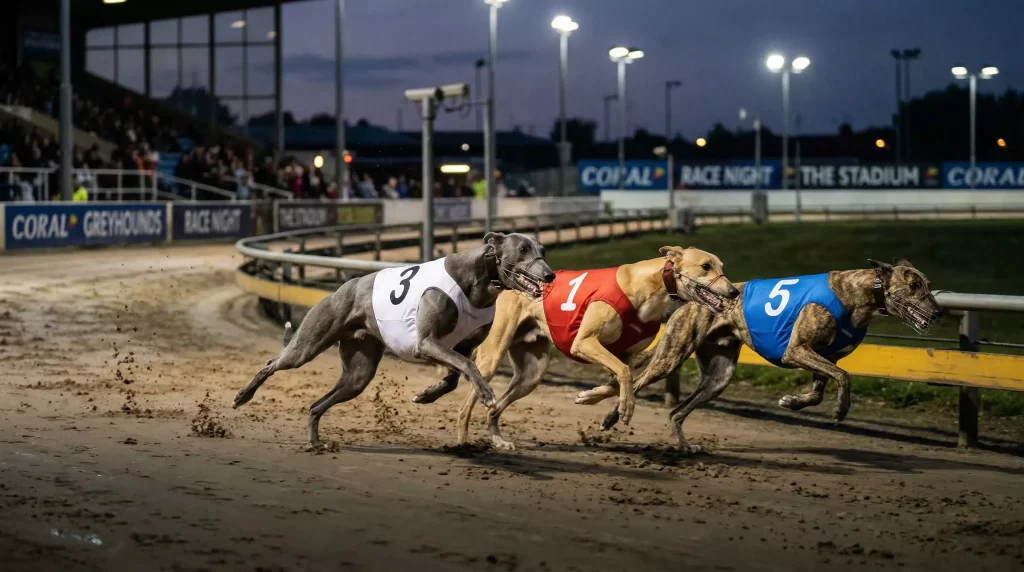
Greyhound racing offers tricast betting with its own distinct characteristics. The fundamentals remain the same—predict the first three finishers in exact order—but field sizes, race dynamics, and payout structures differ meaningfully from horse racing.
The most obvious difference is scale. Horse racing tricasts require eight or more declared runners; greyhound races typically feature six dogs. Fewer runners means fewer permutations, which generally translates to lower dividends. But greyhound racing compensates with volume—dozens of races run daily at tracks across Britain, providing constant tricast opportunities.
Trap draws replace the stall draws of flat racing, and their influence is arguably more pronounced. A greyhound’s starting trap significantly affects their racing line, particularly at tight tracks where inside positions dominate. Understanding trap bias is essential for greyhound tricast success.
Races last roughly 30 seconds for standard distances, compared to one to four minutes for horse races. This compressed timeframe intensifies the action but also means there is less opportunity for tactical changes during the race. Early pace and trap position often determine the outcome before the first bend is reached.
For punters familiar with horse racing tricasts, the transition to greyhounds requires adjustment but not a complete reset. The core skill—identifying which three runners will fill the places and in what order—remains paramount. The context simply changes.
Greyhound Tricast Betting — More on this topic at tricast horse racing.
Field Size Difference
Standard greyhound races feature six runners, one in each numbered trap. This is dramatically smaller than horse racing handicaps, which require eight or more and often attract 12 to 20 runners for major events.
The mathematics are significant. A six-runner race produces 120 possible 1-2-3 permutations (6 × 5 × 4). An eight-runner horse race produces 336 permutations. A 16-runner handicap produces 3,360. The fewer permutations in greyhound racing mean any individual tricast has a higher probability of success—but this is reflected in lower dividends.
With only six dogs competing, the task of identifying three that will fill the places becomes more tractable. Form analysis focuses on a smaller pool of candidates. The market concentrates, and standout runners are easier to identify. This increased predictability compresses tricast payouts compared to the chaotic cavalry charges of big-field horse handicaps.
Some greyhound meetings feature races with five runners due to withdrawals, or occasionally marathon events with eight. The standard, however, is six. This consistency means greyhound tricast punters always know roughly what they are working with—a compact field where getting the 1-2-3 correct is challenging but not astronomically difficult.
Races run frequently throughout the day. A typical evening card might feature 12 races across three hours, compared to perhaps six or seven on a horse racing card. This volume allows tricast punters to place multiple bets in a single session, spreading risk across many opportunities rather than concentrating on a few.
The flip side: lower potential payouts per race mean building significant returns requires either larger stakes or exceptional strike rates. Greyhound tricasts rarely produce the four and five-figure dividends seen in big horse racing handicaps.
Trap Draw Importance
Greyhounds break from numbered traps arranged across the track width. Trap 1 is closest to the inside rail; trap 6 is furthest out. This positioning profoundly affects racing dynamics, particularly on tight, turning tracks.
At many British greyhound tracks, inside traps enjoy significant advantages. The dog in trap 1 has the shortest route to the first bend. If they show early pace, they can establish position on the rail and maintain it throughout. Dogs from wider traps must either possess exceptional speed to lead into the bend or accept racing wider, covering more ground.
Track-specific bias varies considerably. Some courses—particularly those with long straights or sweeping bends—reduce the inside advantage. Others amplify it. Punters serious about greyhound tricasts research trap statistics for each venue, identifying where certain positions consistently outperform.
The parallel to horse racing’s draw bias is clear. Just as the Victoria Cup at Ascot saw results compressed when high-draw horses dominated—aligning with course tendency—greyhound tricasts pay less when inside traps fill the places as expected. The CSF formula adjusts for predictability; results matching known biases produce lower dividends.
Running style interacts with trap position. An early-pace dog from trap 1 is ideally placed. A closer who likes to come from behind might prefer trap 6, avoiding traffic and having room to manoeuvre. Matching running style to trap draw is fundamental to greyhound selection.
Before placing a greyhound tricast, check the trap draw and consider each dog’s preferred racing pattern. A well-drawn fast beginner has different prospects than an awkwardly-drawn closer in a field of pacey rivals.
Payout Expectations
Greyhound tricast dividends typically range from double figures to low hundreds. A straightforward result with short-priced dogs might pay £30 to £50. An unexpected outcome with outsiders filling the places can reach £200 to £400. Dividends exceeding £500 are uncommon; four-figure payouts are rare.
Compare this to horse racing, where tricasts routinely pay hundreds and occasionally reach five figures. The record UK tricast of £95,077.79 came from a horse race at Bath. No greyhound tricast approaches such figures because the smaller fields cannot generate equivalent complexity.
This does not make greyhound tricasts unattractive—it simply places them in a different betting category. They suit punters seeking steady, moderate returns rather than life-changing payouts. The increased predictability means strike rates can be higher, offsetting the lower individual dividends.
Combination tricasts in greyhound racing cost £6 (six permutations at your unit stake) just as in horse racing. Given the lower typical dividends, the maths favour straight tricasts more often. If you are confident in the order, the combination premium consumes a larger percentage of your potential profit.
Stakes should reflect expectations. A £1 straight tricast paying £80 returns solid profit. The same stake on a combination, costing £6, reduces net profit to £74. In horse racing, where dividends often exceed £500, the £5 combination cost is proportionally trivial. In greyhounds, it matters more.
Some punters use greyhound tricasts as practice for the more complex horse racing version. The faster races, frequent opportunities, and more predictable outcomes provide a learning environment before tackling 16-runner handicaps at Ascot.
BAGS racing—the daytime fixtures broadcast to betting shops—provides particularly high volume. These meetings run throughout the day from multiple tracks, offering near-continuous tricast opportunities for punters who want to stay engaged across a full session.
Evening meetings at major tracks like Romford, Monmore, and Towcester attract stronger fields and more betting interest, often producing slightly higher dividends due to increased market activity and occasionally less predictable results.
Different Track, Similar Thrill
Greyhound tricasts offer the same fundamental challenge as their horse racing counterparts: predict the 1-2-3 in exact order. The execution differs—smaller fields, trap draws instead of stall positions, more frequent races, lower dividends—but the analytical satisfaction remains.
For punters seeking constant action, greyhound racing delivers. Dozens of tricast opportunities arise daily. For those chasing headline payouts, horse racing’s larger fields provide better prospects. Both have their place in a varied betting portfolio.
Study trap statistics. Match running styles to draw positions. Adjust stake sizes to reflect lower expected dividends. Greyhound tricasts reward form study and tactical thinking just as horse racing does—simply on a different track with a different pace. The dogs run faster, the races finish sooner, and the next opportunity is never far away.
See also Tote Trifecta UK.
